Tables: Practical variations
The Quality Toolbook >
Tables > Practical variations
When to use it | How to understand it |
Example | How to do it | Practical
variations
<-- Previous |
Next
-->
Practical variations
- Write column headings vertically or diagonally, to enable multiple, narrow columns to be used.
- Use multi-level titles on rows and/or columns to effectively produce a multi-dimensional table. This can enable complex conclusions to be drawn, for example in the table below, it can be seen that the bronze items generally do better than pewter, and bronze castings of figures are particularly strong in the south. This might lead to an investigation into how pewter items are marketed.
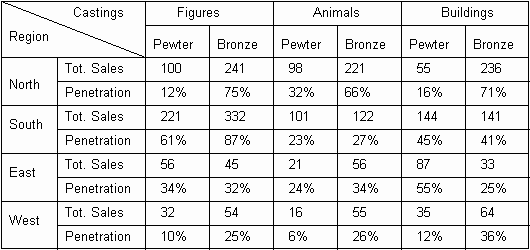
Fig. 1. Multi-level table
- Use one set of titles, for either rows or columns. In this case, the titles in the other dimension are effectively added as a part of the data in the table, as below.
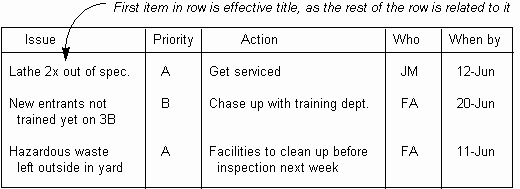
Fig. 2. First row as titles
- The Be-Know-Do Grid is used for selecting people for tasks and positions in a project by separately identifying (a) human qualities ('being') such as creativity, extroversion and tenacity, (b) learned abilities ('knowing') such as experience of specific tools and methods, qualifications, etc., and (c) specific tasks that require doing. These three can form columns, with people or roles as rows, or being and knowing are columns with doing as rows.
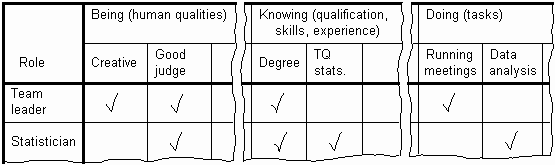
Fig. 3. Be-know-do Grid
- The Fact Table is used to help identify useful data by sorting pieces of information according to how verifiable and useful they are, as
below .
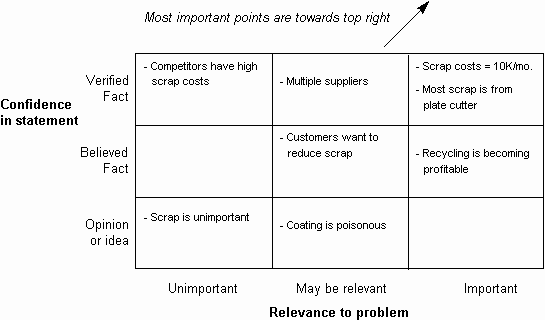
Fig. 4. Fact Grid
- Is-Is Not Analysis
is used to help define the boundaries of a problem by identifying what is and what is not relevant in a number of selected areas, as
below.
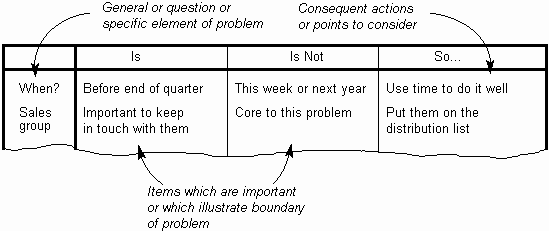
Fig. 5. Is-Is not Analysis
- A SWOT Analysis (Strengths, Weaknesses, Opportunities and Threats) uses a simple four-square table, as
below. to guide investigation of internal/external positives/negatives in any situation, such as when improving the marketing strategy for a new product. This can then lead to specific plans to improve negatives and build on positives.
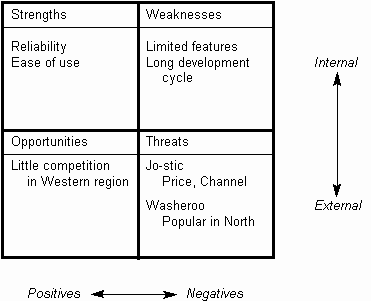
Fig. 6. SWOT Analysis
- The Resource Allocation Matrix, (or RAM) is used in initial planning, to allocate tasks to people. This has tasks in rows and people in columns. The titles can be shown as a hierarchy, for example to show task groups and people's work departments.
<-- Previous |
Next
-->
|