The Psychology of Quality and More
|
|
The Psychology of Quality and More |
|
A Toolbook for Quality Improvement and Problem Solving (contents) |
Tables: How to understand itThe Quality Toolbook > Tables > How to understand it When to use it | How to understand it | Example | How to do it | Practical variations
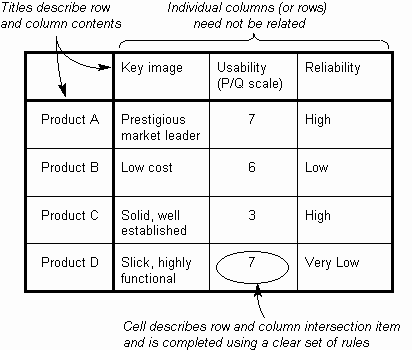
How to understand itWhen working with problems, it is common either to have little information and little idea of what information is needed, or to have plenty of information which is fragmented and disorganized. A simple table can help in either of these cases. For situations with little information, the table can provide prompts for the information to collect, and provides an organizing framework for situations with much information. The basic table consists of titled rows and columns, with cells at their intersection that contain items pertinent to the row and column title, as in the illustration below . Cells can contain different items such as numbers, single words, sentences or diagrams. Row titles and column titles do not have to be completely homogeneous; it is common to have one dimension containing closely related titles with the second dimension having titles which relate to the first dimension's titles, rather than each other.
Fig. 1. Table rows and columns
One of the most important aspects of using tables is in selecting the right row and column titles, as incorrect selection can result in the wrong information being collected, the right information being missed or poor interpretation of the information in the table.
|
Site Menu |
|
Quality: | Quality Toolbook | Tools of the Trade | Improvement Encyclopedia | Quality Articles | Being Creative | Being Persuasive | |
|
And: | C Style (Book) | Stories | Articles | Bookstore | My Photos | About | Contact | |
|
Settings: | Computer layout | Mobile layout | Small font | Medium font | Large font | Translate | |
You can buy books here |
|
And the big |