The Psychology of Quality and More
|
|
The Psychology of Quality and More |
|
A Toolbook for Quality Improvement and Problem Solving (contents) |
Flow Process Chart: How to understand itThe Quality Toolbook > Flow Process Chart > How to understand it When to use it | How to understand it | Example | How to do it | Practical variations
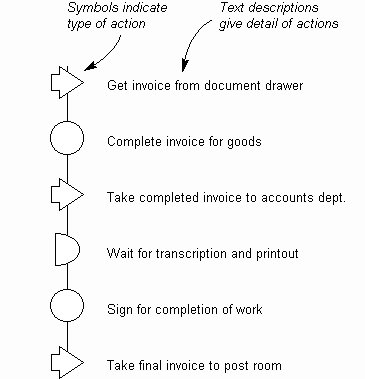
How to understand itMany physical and manual processes consist of sequence of mostly simple actions, such as moving, waiting or inspecting. If these individual actions are identified, then it becomes easier to find ways of improving the process. The Flow Process Chart records the steps in a process along a vertical line, with the action type being shown by a symbol alongside a description of the action, as in the illustration.
Fig. 1. Flow Process Chart
An important aspect of this type of chart is that it can be drawn as the process happens, for example by a person watching it. This makes it quick and easy to do and ensures that what actually happens gets recorded, rather than an idealized or abbreviated view that can come from using other process diagramming techniques. There are three types of Flow Process Chart, depending on what is being charted: a man-type chart shows the actions of a person; a material-type chart shows what happens to a product or item; an equipment-type chart shows how a tool or other piece of equipment is used. The most common symbol set used was developed by the American Society of Mechanical Engineers (ASME), and is shown in Table 1, below.
Table 1. ASME flow process symbols
When analyzing a process, some action types become obvious candidates for improvement, such as long delays and excessive transport (which sometimes are hidden as a series of smaller actions). Individual operations may be broken down again or otherwise examined further, especially if they are difficult or costly.
|
Site Menu |
|
Quality: | Quality Toolbook | Tools of the Trade | Improvement Encyclopedia | Quality Articles | Being Creative | Being Persuasive | |
|
And: | C Style (Book) | Stories | Articles | Bookstore | My Photos | About | Contact | |
|
Settings: | Computer layout | Mobile layout | Small font | Medium font | Large font | Translate | |
You can buy books here |
|
And the big |