The Psychology of Quality and More
|
|
The Psychology of Quality and More |
|
A Toolbook for Quality Improvement and Problem Solving (contents) |
Decision Tree: How to understand itThe Quality Toolbook > Decision Tree > How to understand it When to use it | How to understand it | Example | How to do it | Practical variations
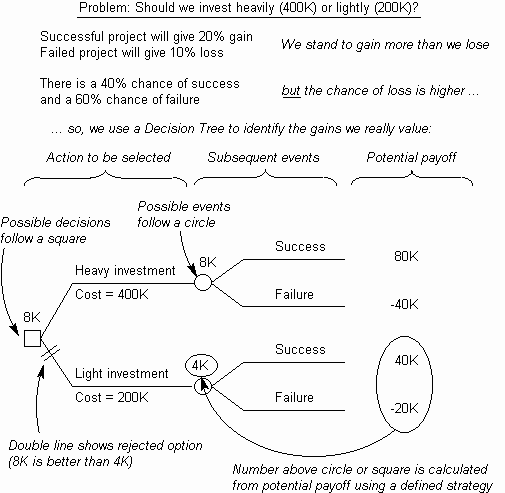
How to understand itMaking decisions can be difficult when future events are uncertain and can give widely varying results. For example, where there are several possible improvements to a product, each of which has a different cost and where each has several possible failure modes. The decision then becomes a 'numbers game', where the aim is to identify those actions which will give the best results whatever events may occur. The Decision Tree is used to evaluate possible actions and subsequent events in order to gain a numerical value by which the best action can be selected, as illustrated. Actions and possible subsequent events on the diagram are differentiated by the shape of the point from which they spread, with numeric values indicating the best decision at each point.
Fig. 1. A Decision Tree
A key part of using the Decision Tree is in selecting the strategy for determining the real present value of the potential payoffs. For example, an approach based on minimizing loss may be selected in preference to one which focuses on the probability of events occurring. Various strategies and their affects on choice are illustrated. Decision Trees can deal with more than just one set of actions and subsequent events, as the occurrence of an event may trigger another decision point. For example, a project failure might require the appropriate contingency action to be selected. Thus Decision Trees can become quite deep as chains of possible events and decisions are considered. To increase the space on the page for multiple levels, it is common to use codes instead of phrases for actions and events, as illustrated, although this can reduce the immediate readability of the diagram. Decision Trees are constrained in the same way as other data-driven tools in that their value is very much affected by the accuracy of the data being used. Thus, for example, if probabilities are rough estimates rather than extrapolations of measured trends, then the results must be considered in this light.
|
Site Menu |
|
Quality: | Quality Toolbook | Tools of the Trade | Improvement Encyclopedia | Quality Articles | Being Creative | Being Persuasive | |
|
And: | C Style (Book) | Stories | Articles | Bookstore | My Photos | About | Contact | |
|
Settings: | Computer layout | Mobile layout | Small font | Medium font | Large font | Translate | |
You can buy books here |
|
And the big |