Process Decision Program Chart (PDPC): Practical variations
The Quality Toolbook >
Process Decision Program Chart (PDPC) > Practical variations
When to use it | How to understand it |
Example | How to do it | Practical
variations
<-- Previous |
Next
-->
Practical variations
- PDPC elements may be informally added to any plan or other appropriate diagram (such as a Flowchart), simply by drawing directly on the plan as risks are identified. This is simpler than the above process, but may identify fewer risks and countermeasures. Which approach to take should be selected on the importance of identifying and handling any critical risks.
- Instead of identifying risks and countermeasures, the objective can be reversed with PDPC being used to identify opportunities and ways of increasing the chance of these 'side benefits' occurring.
- The countermeasures to be implemented can be identified after they have been added to the PDPC. This is usually shown by putting a 'O' next to accepted countermeasures, and 'X' next to rejected ones.
- If the plan is displayed in a text hierarchy, then the PDPC can be implemented in the same style, using two lower levels. The PDPC elements can be made to show up more by using a different style to the plan elements (e.g. italics).
- A simple method of quantifying and comparing a set of identified risks is to calculate the Risk Exposure (or Risk Impact). This is simply the probability of the risk occurring multiplied by the cost, should the risk occur, as illustrated below. This can be used even where exact figures are not known, provided that reasonable comparative estimates can be made.
This method uses probability-times-cost to give an effective 'actual value'. It can be understood by considering how the return on a series of bets of $200 at odds of 100 to 1 would be the same as a series of bets of $20 at odds of 10 to 1 (each method will average ($200 x 0.01) = ($20 x 0.1) = $2 return per bet).
- A simple quantitative way of selecting from a set of identified countermeasures is to calculate and compare the Risk Reduction Leverage. This is the reduction in risk exposure divided by the cost of implementing the countermeasure, as shown below. As with Risk Exposure, if exact figures are not known, comparative estimates can still make this a useful method.
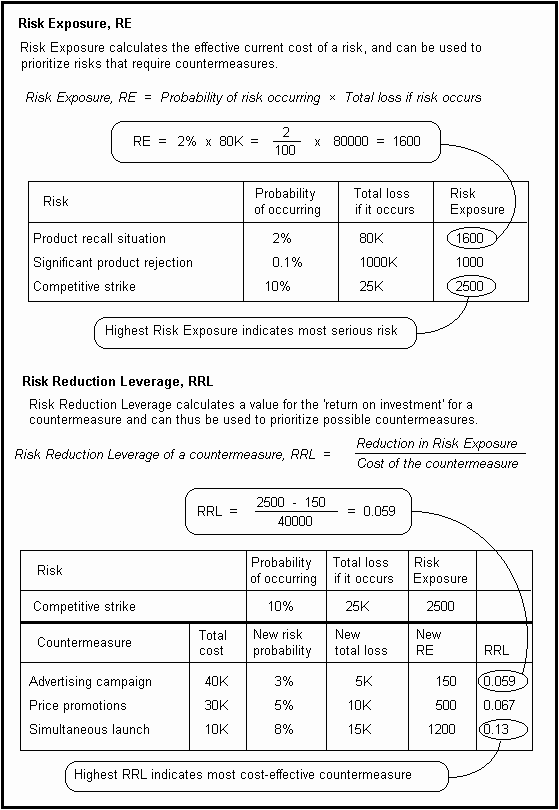
Fig. 1. Risk calculations
<-- Previous |
Next
-->
|