|
|
|
|
|
Books and
more at:
USA:
 UK:
Canada:
|
|
|
|
Failure Mode and Effects Analysis (FMEA): Practical variations
The Quality Toolbook >
Failure Mode and Effects Analysis (FMEA) > Practical variations
When to use it | How to understand it |
Example | How to do it | Practical
variations
<-- Previous |
Next
-->
Practical variations
- Focus first on a limited set of failure effects, and then work back to find the modes that cause them, so these can be addressed. This may be approached by selecting failure effects that customers would find particularly disagreeable. For example, FMEA of a computer system may focus on data loss.
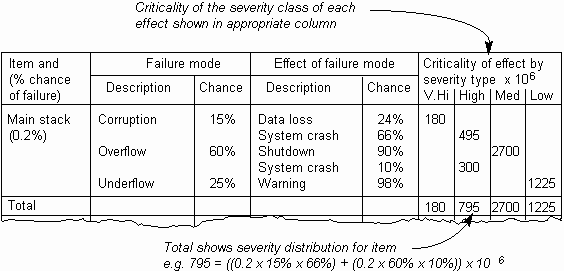
- Identify a set of severity ratings for failure effects and show the criticality of each item in a separate column, as
in the illustration. The sum of each column for each item then shows the severity distribution for that item.

Fig.
1. Calculating criticality
- Use a Matrix Diagram to correlate failure modes and failure effects (put items and modes in rows, put effects in columns). This will allow the connection between a large number of modes and effects to be seen in one diagram.
- MIL-STD-1629 describes two methods of FMEA. 'Method 101' covers basic qualitative FMEA, whilst 'Method 102' covers the quantitative criticality calculation. The recommended columns in the worksheet are described in
the table below.
|
Column title |
Description |
Method |
|
Identification number |
A number for cross-reference to other information. |
Both |
|
Item/functional identification (nomenclature) |
An unique identification or description of the item being investigated. |
Both |
|
Function |
The primary use or function of the item. |
Both |
|
Failure modes and causes |
The failure mode of the item, also how this may be caused (useful for
finding remedies). |
Both |
|
Mission phase/operational mode |
When and how the item is being used when it fails. |
Both |
|
Failure effects |
The detectable effects of the item failure, divided into local effects, next
higher effects and end effects. |
101 |
|
Failure detection method |
The method of detecting the failure. |
101 |
|
Compensating provisions |
Other parts of the system that reduce the effect of failure (e.g.
redundancy). |
101 |
|
Severity class |
Severity of failure effect. Typically from a set of four standard
classifications. |
Both |
|
Failure probability/failure rate data source |
Data source for measurements. |
102 |
|
Failure rate, p |
The chance of the item failing during time, t. |
102 |
|
Operating time, t |
Proportion of test period during which the item is at risk of failure. |
102 |
|
Failure mode ratio, |
The chance of the failure mode occurring during time t. |
102 |
|
Failure effect probability, |
The chance of the effect occurring during time t. |
102 |
|
Failure mode criticality |
The criticality of the failure mode = product of the failure effect
probability, failure mode ratio, failure rate and operating time, (pt). |
102 |
|
Item criticality |
The criticality of the item = the sum of all failure mode criticalities for
the item. |
102 |
|
Remarks |
Pertinent comments. |
Both |
- Weight the criticality values by multiplying them by a numeric
representation of the failure effect severity. This will result in important
effects standing out more clearly, enabling specific actions for these to be
more easily prioritized.
It can be useful to use a non-linear set of severity values (e.g. 1, 2, 8, 25)
to reflect the common situation where serious effects are very much more
important than medium or low effects.
- Weight the criticality values by multiplying them by the chance that
failure will reach a point where it would be especially undesirable (e.g.
reaching the customer). This recognizes that the importance of a failure may
depend on where and when it is found.
<-- Previous |
Next
-->
|
|
|
|