The Psychology of Quality and More
|
|
The Psychology of Quality and More |
|
A Toolbook for Quality Improvement and Problem Solving (contents) |
Design of Experiments (DOE): Practical variationsThe Quality Toolbook > Design of Experiments (DOE) > Practical variations When to use it | How to understand it | Example | How to do it | Practical variations
Practical variations
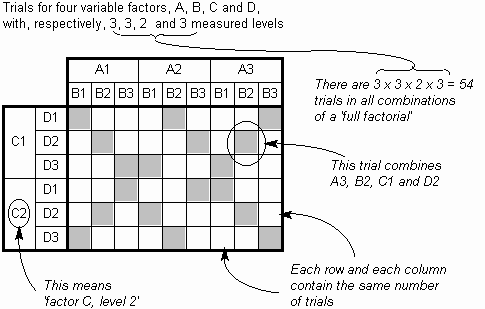
Results may be recorded on the same matrix, and summed in matching boxes opposite the factor/level headings.
Fig. 1. Using a Matrix Diagram
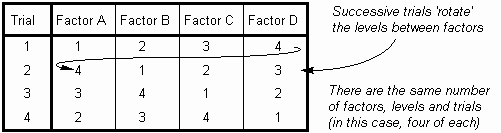
Latin squares have a fairly significant constraint in that there must be the same number of factors, levels and trials. This may be achieved by selecting the number of levels to match the number of factors.
Fig. 2. Latin Square
<-- Previous | Next --> |
Site Menu |
|
Quality: | Quality Toolbook | Tools of the Trade | Improvement Encyclopedia | Quality Articles | Being Creative | Being Persuasive | |
|
And: | C Style (Book) | Stories | Articles | Bookstore | My Photos | About | Contact | |
|
Settings: | Computer layout | Mobile layout | Small font | Medium font | Large font | Translate | |
You can buy books here |
|
And the big |