The Psychology of Quality and More
|
|
The Psychology of Quality and More |
|
A Toolbook for Quality Improvement and Problem Solving (contents) |
MatricesThe Quality Toolbook > Tools for Applications > Tool types > Matrices
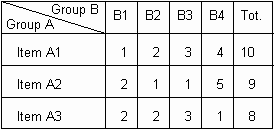
Tools that are numeric and pictorial are usually limited by the complexity of the data that they can display. For example, a complex graph containing a dozen different lines can be extremely difficult to interpret. This type of data may be better shown in a numeric, non-graphical format. These have the advantage of showing exact numbers, but lose the impact and ability to highlight decision points of more graphical displays. DescriptionA matrix shows a set of data in a rectangular format where each of the two dimensions either represents a simple variable or a set of related items, as in the table below. They can often be considered as a form of point graph, where a point is replaced with a cell containing a value rather than a simple mark. Matrices may also be used for non-numeric situations, where cells contain symbols or text rather than numbers.
Fig. 1. Matrix example
Examples
|
Site Menu |
|
Quality: | Quality Toolbook | Tools of the Trade | Improvement Encyclopedia | Quality Articles | Being Creative | Being Persuasive | |
|
And: | C Style (Book) | Stories | Articles | Bookstore | My Photos | About | Contact | |
|
Settings: | Computer layout | Mobile layout | Small font | Medium font | Large font | Translate | |
You can buy books here |
|
And the big |