The Psychology of Quality and More
|
|
The Psychology of Quality and More |
|
A Toolbook for Quality Improvement and Problem Solving (contents) |
Using tools effectivelyThe Quality Toolbook > Making tools work > Using tools effectively Skilful application | Understanding the results
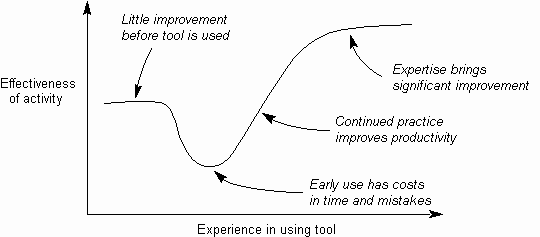
To be effective, a tool must be applied skilfully and the results interpreted to ensure the desired outcome. Skilful applicationWhen a tool has been selected, it requires skill in applying it to achieve the desired results. This skill comes first from the knowledge of what to do, then from experience of actually doing it. This is where books such as this are limited, as they can give you knowledge, but not experience. The first time a tool is used, it is unlikely to be as effective as when it is used for the fiftieth time, as indicated in the figure below . This learning period can be shortened by ensuring that good knowledge of the tool is gained beforehand and by practising its use in a 'safe' environment before using it in critical real-world applications. Sometimes this practice is not possible, for example with tools which are applied at an organizational level. In such cases, the risks should be recognized and progress with the tool should be slow and careful, stopping often to check. These risks can be significantly reduced by employing an expert to help with the early implementation.
Fig. 1. The J-curve of learning
Understanding the resultsIt is possible to select and use a tool quite intelligently, but this is of no use if no-one understands the results. Interpretation of the results of using a tool is often more skilful that applying the tool to generate those results, as this requires both an understanding of circumstances surrounding the use of the tool and an appreciation of the theory behind the tool. Quality improvement and problem solving tools are often aimed at helping to analyze a situation and give indications of points where decisions need to be made about possible action.
|
Site Menu |
|
Quality: | Quality Toolbook | Tools of the Trade | Improvement Encyclopedia | Quality Articles | Being Creative | Being Persuasive | |
|
And: | C Style (Book) | Stories | Articles | Bookstore | My Photos | About | Contact | |
|
Settings: | Computer layout | Mobile layout | Small font | Medium font | Large font | Translate | |
You can buy books here |
|
And the big |