The Psychology of Quality and More
|
|
The Psychology of Quality and More |
|
A Toolbook for Quality Improvement and Problem Solving (contents) |
Relationship Diagram: How to understand itThe Quality Toolbook > Relationship Diagram > How to understand it When to use it | How to understand it | Example | How to do it | Practical variations
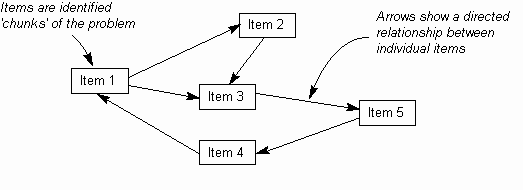
How to understand itIn many problem situations, there are multiple complex relationships between the different elements of the problem, which cannot be organized into familiar structures such as hierarchies or matrices. The Relations Diagram addresses these situations by showing relationships between items with a network of boxes and arrows, as below.
Fig. 1. Items and relationships
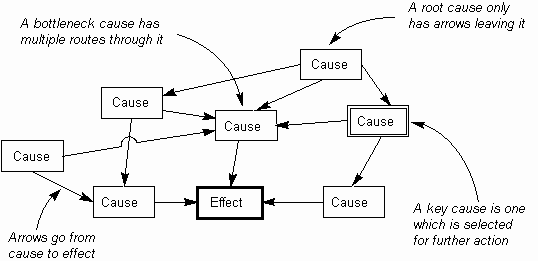
The most common use of the Relations Diagram is to show the relationship between one or more problems and their causes, although it can also be used to show any complex relationship between problem elements, such as information flow within a process. The cause-effect Relations Diagram contains one or more effects and multiple causes, with arrows pointing from cause to effect. The network of arrows is built up as multiple causes interrelate. The result can be considered as a complex Cause-Effect Diagram, as in Fig. 2. Note how causes are visually differentiated from effects. Several useful points may be identified when interpreting a cause-effect Relations Diagram:
A good cause-effect Relations Diagram has a balance of causes and relationships that describes the problem clearly and completely, without going into obscuring detail or being vague and brief.
Fig. 2. Complex causal relationships
|
Site Menu |
|
Quality: | Quality Toolbook | Tools of the Trade | Improvement Encyclopedia | Quality Articles | Being Creative | Being Persuasive | |
|
And: | C Style (Book) | Stories | Articles | Bookstore | My Photos | About | Contact | |
|
Settings: | Computer layout | Mobile layout | Small font | Medium font | Large font | Translate | |
You can buy books here |
|
And the big |